Iam mens praetrepidans avet vagari.
Now my mind, trembling in anticipation, longs to wander.

- Catullus, Carmen 46

Tuesday, June 9, 2015

Central Java's Cultural Twin Cities

We had scheduled an overnight bus to Central Java for the night after our Bromo sunrise hike, so we had most of the day to kill. Walking around Cemoro Lawang in the middle of the day, we realized the entire village had completely emptied out: most visitors come up in the evening, spend the night, and see the sunrise in the morning, booking it back down to town by midday. We ended up having to wait over an hour to scrape together a group big enough to make it worth it for one of the vans to take us down to Probolinggo. We'd only seen the road up to the village in the dark, so it was nice to be able to admire the view on the way down: beautiful mountains in the distance, farm plots alongside the steep road, and lovely little guesthouses here and there that looked like ski lodges. In Probolinggo, we still had a few hours to wait, so we wandered a bit through town and finally had dinner at one of the many food stalls near the bus station. When the bus pulled up, it became clear that it would not be a comfortable ride: we'd opted for the cheaper local bus, but only because the ticket agent had told us that the express bus (with air conditioning, reclining seats, a toilet, and dinner) was too expensive. We found out later that it was only another 8 dollars, which we would have paid for the comfort, so lesson learned. This bus was so packed that people were sitting four to a seat, and on top of luggage in the aisle. It was almost unbearably hot, and it was raining outside so all the windows were closed. Somehow (probably out of exhaustion from the last few days of sunrise wake up calls), I managed to fall asleep and did sleep well until around 5 am, when I awoke to discover that the bus had mostly emptied out during the night.

We reached Solo about an hour after that, and I said goodbye to my traveling buddy (we were splitting up for the day, but would reconnect in the evening) and hopped out. I sat in the Solo bus station for an hour or so, waiting for the day to begin, then left my backpack with a security guard there so I could freely explore without it, and grabbed a cab to the center of the city. Solo used to be the seat of the Javanese Mataram Kingdom, which in the 16th century split into Solo and Yogyakarta. Though Yogyakarta retained some of it political autonomy as a kingdom after Independence and is now the provincial capital of the Daerah Istimewa Yogyakarta (Special District of Yogyakarta), Solo did not, which, many agree, helped to preserve the city's Javanese character and protect it from Westernization by tourists (except me, apparently). This is primarily why I was driven to take the day to see Solo - I was curious about what seemed like untouched Javanese culture.

In the courtyard of the Kraton
It was still too early to check out any of the sights (nothing opened before 9), so I set out from the main road to find breakfast and see the town the way a resident might. Although the main road was bustling with becaks (bicycle taxis) and commuters, the side streets were narrow, winding and paved with cobblestones.The wrought iron street signs and lampposts and the charming little pastel-colored store fronts gave the town a very European feel (apart from all the batik sellers) - the Dutch influence on the island, I suppose. I found a little homestay where I had a delicious breakfast (and fresh, homemade bread) and waited there for more things to open. Just before 9, I made my way to the Kraton, or palace - Solo's main attraction. Just inside the palace, a huge market was just opening, with people selling everything from T-shirts to water guns, and thousands of beautiful and brightly colored batiks. I followed the tall, white wall to the main gain, which was painted a beautiful light blue. Just opposite the gate was a red and brown pavilion, with gold trim and marble floors. Inside the gate, the main palace ran around a small courtyard. The walls were all powder blue and white. Most of the grounds were closed to tourists, but it was nice to look around outside. Oddly, there were Greek statues all around the courtyard, and (less oddly) paintings of past and present sultans and royal family members hung on the walls. I was the only western tourist there, but there were a handful of local tourists, one of whom told me that the paintings were all done by the prince. The rooms of the palace (no longer in use as a royal residence or center of government) have been converted into a museum, where more paintings hang around a collection of Hindu art, some gorgeous masks, and "wayang kulit" (leather shadow puppets: my favorite things in Java).

Greek sculptures in the Kraton

Kraton wall

Kraton wall

Portraits in the museum
Entrance pavilion at Istana Mangkunegaran
I left the Kraton and headed for Solo's second palace: the Istana Mangkunegaran, which is still where the prince and his family live. I was required to have a guide to tour the inside, but since I was the only tourist there, it ended up being a private tour of the building, which was very interesting. The guide was extremely knowledgeable about the structure itself as well as the pieces on display inside. The Istana is, in my opinion, far more beautiful than the Kraton - decorated in the same light blue color, but with painted batik patters on the columns and the walls, and with beautiful marble floors. The museum houses collections of the prince's jewelry, coins, medals, and weapons, along with things he has acquired from various trips abroad. We went out through the garden, which was beautiful and sunlit, and humming with the activity of its avian residents.


Birdcage outside Istana

Palace garden
After a great day in Solo, I headed to Yogyakarta, about an hour away by bus. I had a little trouble finding the guesthouse: I followed so many people's wrong directions that I got completely turned around. With no map or wifi, and after it started pouring and I was completely drenched, I finally grabbed a becak. The driver apparently didn't know the place any better than I - he asked several people on the way, took me to the wrong place, and finally deposited me at the guesthouse, soaked and shivering. Meeting back up with my travel buddy, we spent the evening exploring Yogyakarta by night. We had dinner on the main shopping street, Jalan Malioboro, and walked the length of it to see what was happening there. A lot: street vendors selling all sorts of things for tourists as well as locals, and food stalls set up with blankets on the ground for people to sit upon at the low tables. Exhausted, we headed back to the guesthouse and fell into bed, completely exhausted.


Prambanan main complex
Yogyakarta is one of Java's most visited cities. This is due, at least in part, to its proximity to two major temple complexes: the Hindu Prambanan complex and the Buddhist Borobudur temple. While tours to both abound and are easily booked at one of the millions of tourist agencies along Jalan Malioboro, we decided to head solo to Prambanan, which was incredibly easy. We hopped on one of the city buses, took a 40-minute ride to the last stop, and then walked a couple of blocks to the temple. Knowing we'd visit Borobudur the following day, we decided to buy the combined ticket (good for two days, and a lot cheaper than buying the two separately). I was also able to use my (expired, but no one commented) student ID for a 50% discount, so the whole thing was reasonably cheap. We also decided to hire a guide to take us through. I wasn't too impressed by him, and he ended up leaving us at noon because he needed to pray (fair, but I thought he might have told us that when we hired him at 11). The Prambanan complex is made up of several different temples, but the largest and most impressive is Candi Prambanan. We walked through that one first. It was massive: three main structures rising from the ground, surrounded by piles of rubble and stone blocks: the remains of 200-odd stupas damaged by the 2006 earthquake. Although reconstruction has begun, and the 8 main temples have been rebuilt, it is slow-moving, and highly unlikely that it will ever be completely rebuilt. The first temple we entered was the largest: the Shiva temple, dedicated to its namesake god. We climbed the steep stone stairs, to look out over the grounds (I can't imagine how it must have looked when all of the temples were intact). The stone work was still fabulous, though: the outsides of the structures are covered in upside-down lotus leaves, and inside the chambers of Shiva's temple are batik-desisn carvings. The first two chambers house statues of Shiva himself; the second, his son, Ganesh; and the third, his 8-armed wife. All around the temple are reliefs depicting the story of Rama and Sita. We climbed back down the steps and headed to the Brahma temple, which was much smaller than the Shiva temple. It contains only one chamber, housing a statue of the four-headed Brahma (four heads for the four main elements of the world). From there we went to the Vishnu temple. Similar in size to the Brahma temple, it also contained only one chamber, with a statue of Vishnu.


We left the main complex on a trolley that circles Prambanan to see a few of the other, smaller temples. Unfortunately, it started to rain, so we only briefly hopped out to see the Sewu temple, a pretty big complex, guarded by two statues at the gate. It was well-preserved, and I would have liked to have explored, but the rain was getting heavier, so we decided to take refuge in one of the covered food stalls just outside the gates of the temple. We trudged through the rain back to the bus stop and returned to Jalan Malioboro.


By the time we got back to the city, the rain had passed entirely, so we decided to spend the rest of the day out and about. We walked through the Water Palace, a series of old canals. There's not much to see there, but it did lead us out to peer over the roofs of the neighborhood. Then we headed back to the guesthouse. We had a nice dinner on one of the side streets near Jalan Malioboro, and then went to bed.
Activity on Jalan Malioboro

Inside the Water Palace

Rooftops from the Water Palace

Gate at Taman Sari
The next morning we headed out at 3:30 am for another sunrise - this one over the Borobudur temple complex. Unfortunately, it was raining, so no only did we fail to see the sun come up, but also made the mud stairs more like a slip and slide, and we clung desperately to the ropes that served as hand rails to make our way up. Once it got a little bit lighter, we could see the mountain tops rising like islands out of the misty fog, but the only thing we could see of Borobudur was the very top of the temple peeping up through the haze.


The eastern wall of Borobudur

From there we headed to the temple itself. At 6 am, it was just opening, but there were several school groups, full of kids begging for photos with us. Thankfully the rain seemed to have cleared up, although it was still pretty cloudy. We walked to the base of the enormous stupa and were completely blown away. It was so massive,  and gorgeous even from afar. We approached by walking down a long path lined with flowerbeds, with the temple looming in front of us. As we climbed the stairs we admired the view from each level. The temple consists of six square terraces and three circular terraces, which wrap around the central stupa. We walked straight up on the eastern wall, and then spiraled our way back down, trying (unsuccessfully) to take in the sheer size of the place, and astonished at the detailed wall carvings. The loveliest parts, in my opinion, were the bell-shaped stupas that dotted the upper terraces, with Buddha statues placed intermittently among them. As we worked our way down, we looked over the reliefs that cover the walls of the temple. It would have been nice to have had a guide to talk us through the stories depicted there, but it was fine to just wander through and admire them. The museum at the bottom, though small, gave us some idea of the purpose of the reliefs: they depict the three Buddhist worlds (the world of passions, the world of forms, and the formless world).

Early morning crowds at Borobudur 

One of the guards of the temple

Bell stupas at the top

The temple, like most of Central Java, is surrounded by
 mountains and active volcanoes


From the top


We headed back to Yogyakarta, where we had the whole afternoon, since we'd gotten to Borobudur so early. We headed to the Kraton - the Sultan's palace. It was simple, like the palace in Solo, but charming, with lovely accents on the white walls and batik patterns painted onto the lampposts. One pavilion was especially gorgeous: black with gold accents and beautiful chandeliers hanging from the ceiling, with the whole thing encased in glass. The various chambers held portraits of the sultans as well as silverware and glassware. The courtyard itself was nice, too, though not as green as the garden at the Istana in Solo. It was filled with trees, several lampposts, and the quaint but pretty buildings, including the spectacular stage where the dance performances are held.


Students working on their batiks
We had a typical Yogyakarta lunch of nasi gudeg (a rice dish made with jackfuit, coconut milk, palm sugar, and an array of spices, and traditionally served at low tables on the floor). Walking along the street, we met a street vendor who told us he was a musician who played with the shadow puppet show held every evening. After talking briefly to him, he suggested we check out the Batik Art School. Someone else had mentioned that too, so we decided to take his advice. He walked us part of the way there, and when we asked someone else for directions, he walked us the rest of the way. This second helpful person was thrilled to hear where we were going: he was so excited to meet tourists who'd heard about the school. When we got there, we met one of the teachers, who introduced us to two of his students as they sat working on their batiks. He talked us through the (tedious) process of dyeing and painting and coating with wax and dyeing again, explaining that each color must be done as a separate layer. He gave us a chance to look around the fabulous pieces in the gallery: students' work as well as instructors'. Some were very simple patterns, while others were incredibly detailed pieces.
Batik gallery
That evening we went to see the puppet show. It was all in Javanese, and it was much longer than I'd anticipated (over two hours), and the room was absolutely freezing, but it was so fun: I love the shadow puppets, which are fabulously hand painted (although you can't tell from their shadows alone, obviously) and I knew the outline of the story (the same Rama and Sita story that I'd encountered several times already). Our musician friend had already warned us that the music would be in a very different style than the dance I'd seen in Bali, despite the story being the same. He'd said that the Balinese cuisine is spicy, and their music is fast, which is why Balinese people are rushed and hot-tempered, but Javanese cuisine is sweet, and the music is slow, which is why Javanese people are more relaxed and helpful. Stereotype or not, this had already proven true in terms of food and people, and the music was indeed much slower and calmer.

Puppet-maker hammers holes into one of his puppets
The next day was our last in Yogyakarta. We wandered through the local market, which was absolutely packed and wild, with people haggling and shouting: just what a market should be. There were miles of batik fabric, barrels of handicrafts, and a couple of people breaking apart huge blocks of rock sugar. Then we continued on to the Sonobudoyo Museum, which houses a collection of Javanese art, including gamelan (Javanese dance) sets, shadow puppets, and stone work. While having lunch at a stall on the street, someone sat down next to us, asking where we were from, how were were liking Yogyakarta, and where we'd already been. He asked us where we wanted to go next, and we really didn't have any ideas, so we asked for a suggestion. He pointed us to the shadow puppet workshop, and even got us a fairly priced becak to take us there. The puppet workshop was incredibly cool: we watched one man hammering tiny holes into the unpainted leather, and compared his work with the finished product, where all the details really popped. A second puppet-maker was carefully painting the wing of one puppet, and he told us that the painting can take up to a full week for a single puppet. We paused at another stall for a cup of tea, and the owner told us about a silver workshop: he also found us a becak to take us there. The workshop was very small, and not as interesting as the Batik school or the puppet workshop, but still a nice way to spend a half hour. We headed back to the center of the city, where we had a great last dinner and went to a bar with live music before turning in for the night.

Solo was something of a last-minute decision. There wasn't a whole lot there, but I had a nice time wandering in the streets and seeing the palaces. It was more than worth the day trip there. Yogyakarta was one of the highlights from the time I started planning the trip. I'd heard and read such good things, and knew that the temples were must-do's. The city itself was such a fun place to be: the people were incredibly kind, the tempo of the place was slow and relaxed, and the culture there was fabulous. We did the right thing by taking it a little slow, spending several days in town and giving ourselves time to just explore the streets. I'd go back in a heartbeat.

Thursday, June 4, 2015

At the Caldera of Mt. Bromo


After a very intense morning at the sulphur-filled Kawah Ijen, our next destination was the far more popular Mt. Bromo - another of Java's volcanoes west of Ijen. We had our Jeep driver from Ijen drop us at the Banyuwangi bus station, where we argued over the price of a ticket to Probolinggo (I'd read that the price should be 30,000 Rp, or just over $2, but the tout tried to charge us 70,000. In the end, we only got the price down to 60,000). The bus was hot, but not too crowded, and I slept for the first few hours. We ended up having to change buses, although no one had said so beforehand, but the second bus wasn't packed either. I watched out the window as we passed through the beautiful Javanese countryside: pine forests, rice fields, and small towns surrounding beautiful mosques. We arrived at Probolinggo around 5 in the evening, and without much trouble (everyone knew why we were there), we were directed to an agent who could arrange a bus up to Cemoro Lawang, the starting point for Bromo treks. The agent was extremely helpful, providing us with a map of the hiking trails, tips on avoiding the national park entrance fee (he told a similar story as the guides at Komodo National Park: the national government has recently raised the park entrance fees, but seems to be just pocketing the extra profit, without providing any extra services or maintenance, so the park rangers occasionally help tourists evade what they see as corruption), and even booking us an onward bus for a few days later. Unfortunately, he was not extremely helpful in arranging the bus up to the village, explaining that we'd have to wait for more tourists to arrive, since the bus wouldn't take just the two of us. Luckily, he said, there was a trainload of people arriving at 8, and the bus would be happy to take us with them. We were reluctant to wait three hours, so he offered to lead us to another bus, where seven people were waiting. We arranged with the driver to pay a bit more since we still weren't a full load, which was a bit annoying, but we were happy to get a move on. There are a couple of decent places to stay in Cemoro Lawang, but the majority of the accommodation is homestay-style, and those are notoriously crummy. The one we ended up in was no exception, but we were tired enough after our early start and long hours of travel that we decided to put up with it for the night.

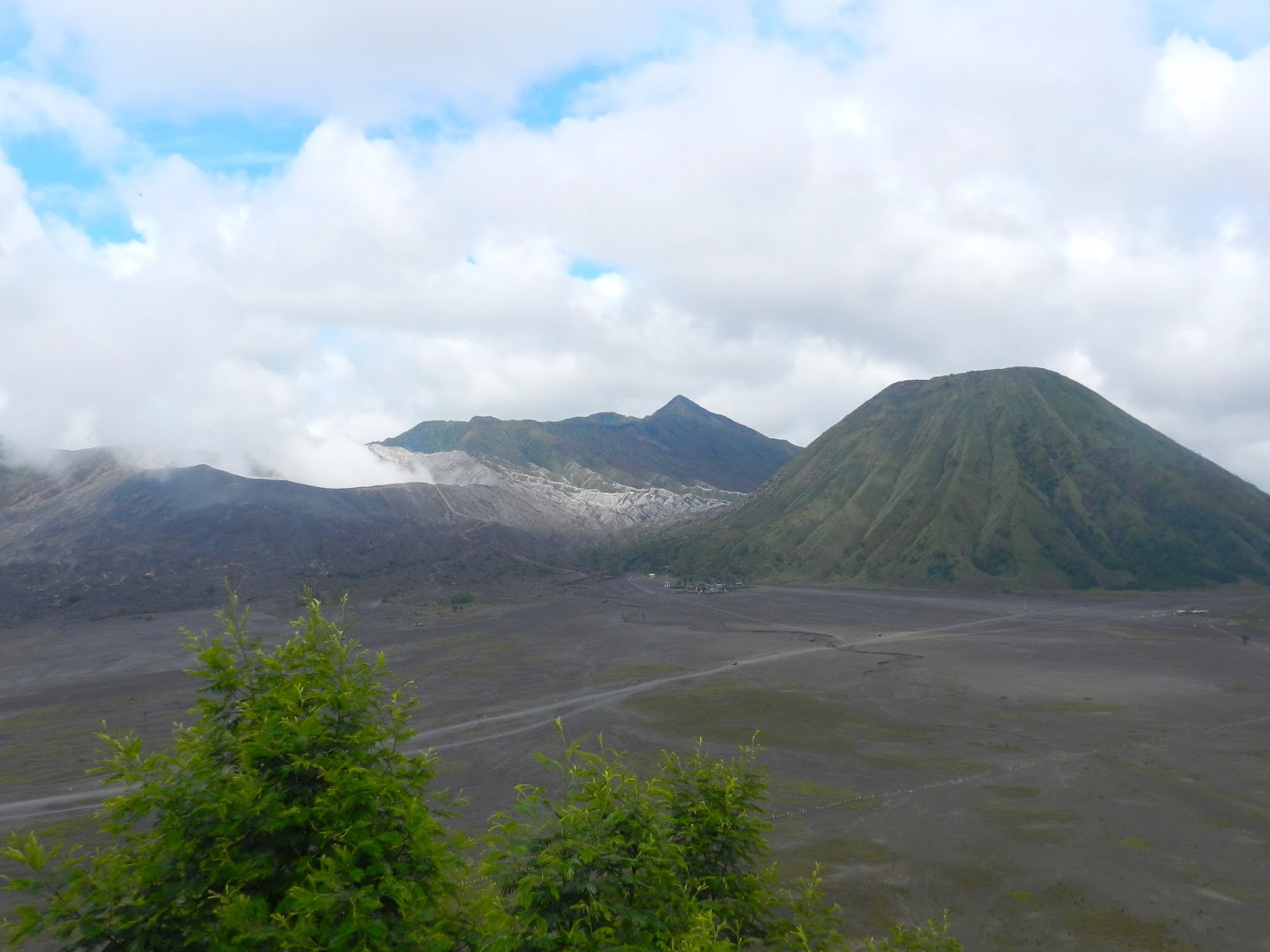
Bromo and Batok
In the morning, we headed to one of the cleaner hostels for breakfast, and found that they had an open room (they'd been full the previous night), so we decided to move there for our second night. The room was still small, and pricier than it was worth, perhaps, but the space was clean and the showers were hot. After we'd moved our bags and gotten settled, we spent the day walking to see Mt. Bromo's crater. We learned that the guards at the gate to the park don't typically ask for the fee after the sunrise crowd, and especially not to people on foot (many choose to approach the crater via motorbike or on horseback, but the walk is easy and not too long). We followed the main road and came to a small lookout point where we could see the caldera below us, with Mt. Bromo and neighbor Mt. Batok rising out of the ashy caldera floor. Mt. Bromo was small, but its size was redeemed by the curls of smoke rising from the top of it. Batok was much taller and completely green, contrasting with the barrenness of the rest of the caldera. The road descended steeply into the caldera, and from there the expanse of black soil spread out in front of us, the flat caldera floor punctuated there and there by mountains, and a series of cracks that traced the lava flow from Bromo's most recent eruption. As we approached Bromo itself, we passed the Hindu temple at the foot of Mt. Batok, and waved off the many people selling peanuts and offering horseback rides up to the mountain.
On the caldera floor

A peanut seller walks across the caldera

Hindu temple and Mt. Batok


Staircase to crater
From the foot of Bromo is a staircase up to the mouth of the crater. Prior to the 2011 eruption, it was possible to climb down into the actual crater, but these days, tourists must content themselves with a glimpse over the edge. Near the top of the staircase, we started to smell the sulphur (but nothing compared to Kawah Ijen!). From the guardrail running around the crater, we could see the clouds of smoke pouring out of the mountain. Whenever it cleared somewhat, making it possible to see deeper inside, we could see that the walls of the crater were grey, with lines of bright yellow sulphur rock. We stayed up there for quite some time, watching the smoke and surveying the landscape below. Then we made our way back down and across the caldera, to the main road. By the time we'd reached the hostel, the fog that had been moving in all day had descended so that the mountains were invisible. We spent the rest of the day relaxing and walking a bit in the tiny village. We had another sunrise to prepare for.

Mt. Bromo cater


Sulphur streaked in the rock


We'd heard that the clouds in the caldera blocked the sunrise view completely the day before we'd planned to head up, so it was with only a little hope that we headed out at 4 am. Many people had organized a jeep to take them up to see the sun, but we were determined to make the walk, so, map in hand, we set out along the pitch black road. The stars were magnificent, and I thought that might be a good omen for a clear sky when the sun came up. It was an easier walk than Ijen: the road was only a slight incline at first and, though it did get steeper along the way, it was never as strenuous as Ijen's first few kilometers. We reached a small lookout, but it was still too dark to see anything but the shadows of the mountains around. From there the road became even rougher and steeper. Suddenly, we met a huge and noisy school group, who'd come up by bus and was now getting ready to walk the rest of the way (from there the road became stairs so it was inaccessible except on foot). The stairs wound back and forth on the mountain, and were by far the toughest part of the hike. As the sky lightened, there were a few clouds, but we had a clear shot of the caldera below us, and of Mt. Semeru behind it. Semeru is Java's tallest volcano - 3700 meters, and about 15000 meters higher than Bromo. It is an extremely active volcano, and the smoke drizzling out of its crater makes it appear to have a small cloud floating perpetually above its peak. In the dawn, the mountain appeared pink and light purple. As the sun started to rise, the whole valley lightened from grey to pale green to bright green. Once the sun had cleared the ridge to the east of us, the view was breathtaking - the whole caldera spread out before us. We stayed about an hour at the top, completely entranced by the sight.


Friday, May 22, 2015

A Smelly Hike to Hell


Java is an island covered in active volcanoes. My plan for exploring the island, after several days of hopping over from Flores, was to head westward from the very east coast to Jakarta, fitting in as many hikes as possible on my way. When a friend said she was bored of the beach in Bali, I suggested she join me, and we agreed to meet at the ferry dock. After a travel mishap (a bus that took 14 hours instead of 6), I arrived a day late, but everyone got there in the end.

Banyuwangi, the dock on Java's east coast, is also the jumping off point for Kawah Ijen, one of Java's more well-known volcanoes. Ijen is famous for the sulphur that wafts out of the crater, and the blue flames that are visible as the gases combust. It was something I definitely wanted to see, but information was scarce on how to visit without booking a tour. In the end, it wasn't too difficult.

The handful of guesthouses advertised online all seemed equally low quality and overpriced, so we chose one at random. They are mostly situated at various points along the road from Banyuwangi up to the trekking point at Pos Paltuding (there is, I learned later, one camp-style accommodation right at the Pos Paltuding checkpoint, where the trek begins - if I were to return, I'd stay there). Our guesthouse was not too far from the village of Jambu, and I was able to convince a motorbike taxi to take me there all the way up there from Banyuwangi. I pulled up around 7 am (I was desperate to get out of the crummy hotel where I stayed in Banyuwangi and left more or less as soon as it was light). My friend was already there, so we had breakfast at the guesthouse, which was nice-ish and almost entirely empty. Since it was raining, we spent the morning in the chilly restaurant. Another guest showed up around 9 - he'd been to the mountain and back already. We were able to snag his jeep driver for the following morning (after a lengthy negotiation) to take us to the trekking point at 2 am (since the flames are only visible at night), then back to the guesthouse for breakfast and to collect our bags, and then back down to the bus terminal at Banyuwangi. Voila: Ijen without a tour!

Kawah Ijen
In the early afternoon, the rain turned to a light drizzle, so we decided to walk up the road a bit and see what we could find for lunch. We walked toward Pos Paltuding, enjoying the peacefulness of the mostly empty road, and the very green landscape along the mountainside. When it was becoming obvious that there was nothing to eat on the road, we turned around, headed back to the guesthouse. We noticed a small restaurant just beside the guesthouse, so agreed to eat there (they served only Indonesian meatball soup, but it was nice, at least, to have something warm). As we ate, we chatted with the owners - a woman, her husband, and their 20-something son - who spoke a fair amount of English and seemed delighted to have us (more perks of low season travel). When we'd finished, the woman asked if we wanted to pick rambutans. With nothing better to do, we agreed, and she sent us after her son, who led us to his rambutan trees, shimmied up one of them, and proceeded to knock down several branches as we waited below, gathering them up. He then led us to his aunt's house, pointing out various fruit and coffee trees as we walked through the family's farm. His aunt invited us inside, so we sat down on her couch, eating the fruits he'd picked, and chatting about our travel plans. Then the son led us to another family member's house. This one was much smaller and had a mud floor, and several chickens wandering around (waiting, probably, to become nasi ayam). We were offered coffee, which turned out to be homemade from the family's coffee plants outside. It was delicious: a little spicy and very strong. When we'd finished, we decided to continue walking, and the son led us down the main road toward town. We walked through it, although there wasn't much more than a school and several tobacco plants. We saw signs for the "Java Banana Cafe and Gallery," which we thought seemed interesting enough, but when my friend said aloud that she wanted to go there, our guide's eyes widened in shock and he refused to go, saying that it was too far. We continued on without him, which he only allowed us to do once we'd agreed to stop by later (we never did... oops!). The gallery was indeed something of a walk through a neighborhood of very confused people asking where we'd come from, but it sat on top of a hill with a stunning view of Kawah Ijen draped in clouds as the evening fog descended around it. The gallery itself was full of spectacular photographs of Javanese dancers, Kawah Ijen, and the port at Banyuwangi, a handful of sculptures, and (my favorites) Javanese shadow puppets, made of buffalo hide and hand painted in red and blue and gold. As it was starting to get dark, we headed back to the hostel, where we ate dinner and headed to bed early.

Baskets used by the miners to carry sulphur
The next morning our driver arrived at 2 am, and we headed up to the Pos Paltuding trekking point in his jeep. It was completely dark on the road, so we were relieved to find a decent sized group of hikers at the parking lot - we'd worried that we'd be the only ones. The first three kilometers were steep, and we were quickly out of breath. Mingling with the hikers were a handful of sulphur miners, on their way up to begin the day's work of gathering sulphur from the crater. The baskets hanging from the wooden poles that they balanced on their shoulders were empty on the way up, but they would soon be filled with some 100 pounds of sulphur. They were extremely friendly and chatty (especially for 3:00 in the morning) and happy to answer questions about their work, the crater, and the trail. It took us a little less than an hour to reach the weighing station, where we rested a few minutes to get our breath back before continuing up to the crater rim. This second leg of the hike was significantly less steep, as it wound back and forth around the mountain, but the sulphur from the crater started to bother our noses and throats. From the rim, we peered over, but could see very little beyond smoke billowing out from the crater. Up there, the gases were much stronger, and we tied our scarves around our mouths and noses (we'd been unable to procure masks beforehand). As we watched, one of the miners pointed out a faint blue glow - the blue flames we'd gotten up so early to see - but I was thinking, "is that all?" and feeling a bit disappointed. One of the miners offered to lead us down to the crater so we could see better, so we followed him (and the herds of tourists and miner guides) down the path. This part was by far the most difficult: the trail was steep and gravelly and hard to make out, and I had to stop several times to readjust my scarf to keep my nose covered. As we got closer the clouds of gas rising from the cracks in the stone made the air not only uncomfortable, but difficult to breathe. Everyone was coughing and gagging - the only other sound was of the miners banging on the rock to break apart huge chunks of sulphur. The one miner we watched as he was working did wear a gas mask but he still had to stop work and turn away whenever a particularly violent gust of smoke washed over him (I read later that some of the miners collect masks that are discarded by tourists, but that the filters are usually old and the masks are therefore ineffective). From where I was standing, it was painful - I truly couldn't breathe when the gas hit us, and hid my face in the rock behind me. I thought I was going to vomit, or pass out, or cry, or all three. Once the smoke cleared, though, and we got our first real look at the blue flames, I was astonished: they were more than worth it. The blue was brighter and more dazzling even than I'd anticipated, and it was amazing to watch the flames rise up out of the rock. It was dark enough that they were the only light, and seemed just to appear out of nowhere. Eventually, desperately in need of fresh air I led the charge back up out of the crater (I was practically clawing my way out of there). We emerged beside the blue lake, and waited there for the sun to rise and the smoke to clear to get a good look at the color, which is the result of the high concentration of hydrochloric acid there. Around 6, we made our way back down, slowly, to admire the scenery we'd missed in the dark on the way up. There were several volcanoes visible beside Ijen - perfect cones with beautiful, rugged craters. One of them was actually rumbling, but apparently it's nothing to worry about. We returned to the hotel, had breakfast with our driver, and then drove down to the bus station at Banyuwangi, where we found a bus headed for Probolinggo, and Java's most famous volcano: Mt. Bromo.
Blue flames in the crater

Crater rim as the sun starts to rise


Ijen's Blue Lake


At the crater rim

View from the walk back down


Friday, May 8, 2015

Sailing in and out of weeks and almost over a year

After traveling across Flores, and ending up in Labuan Bajo, the island's westernmost point, I was unwilling to spend the money on a flight to Java, my next destination. In searching for a cheaper way to make the trip, I discovered that I could island hop, using a series of ferries and buses, from Flores to Sumbawa to Lombok to Bali to Java. It would take a long time, and be less than comfortable, but it was cheap and seemed straightforward. I was also interested to see the island of Sumbawa, generally ignored by tourists making the Flores-Lombok hop.

View from Labuan Bajo port
There wasn't a lot of conclusive online information about the boat to Sape, the port in eastern Sumbawa, so a day before I planned to head out, I moseyed down to the ferry dock. I was told that the boat would leave at 9 AM, but that I should be there around 7 to ensure a ticket and a seat. I arrived about 7:30, bought my ticket and headed up to the passenger deck. The boat was enormous: it carried huge banana-bearing trucks, a couple of tour buses, and private cars and motorcycles, in addition to the passengers. The passenger deck consisted of three separate areas: one filled with bunk beds lined up side by side, where several local people had already claimed the mattresses on the lower bunks (the tops were bare). There was quite a bit of space left there, but I didn't feel much like lying down all day, so I moved on. The second room was lined with metal benches, and open windows letting in the breeze from the harbor. There was a small cafeteria there, selling noodles, drinks and snacks. The third room was marked "Kelas Bisnis," although there hadn't been any choice of classes when I bought my ticket. Inside were rows of comfortable (ish) leather seats, and the room was air conditioned. It was also at the front of the ship, allowing for views of the sea ahead. I settled in there, and no one said anything, despite my ticket being, officially, "Ekonomi." The cafeteria room filled up quickly, but only a handful of people sat in the Bisnis area. I was the only tourist on the boat and stood out like a sore thumb, but people more or less left me alone. We finally pulled out of the dock at 9:20, and the grainy TVs in all three seating areas started playing "Captain Phillips" (a strange choice of movie for a boat ride, I thought). We passed several, apparently uninhabited islands to the south as we sailed past, rising beautifully out of the sea.

"Ekonomi" Class
Horse cart in Sumbawa

When the eastern coast of Sumbawa came into view (around 4 PM), everyone stood and crowded near the front of the boat. A little cluster of homes were set on a hill along the coast, and  there was a mosque right beside the dock (a reminder that Sumbawa is one of Indonesia's more conservative Islamic islands). I followed the crowd off the boat and was snatched up by someone as the token lost Westerner. He brought me to the bus stand located conveniently at the far end of the dock, and settled me on a bus to Bima, Eastern Sumbawa's biggest town (the few tourists who take this route tend to board a bus to Lombok straight from Bima). The bus was no luxury coach: a small, hot, cramped, public bus with no air conditioning or leg room. My backpack got strapped to the roof and I squeezed in, already hot and sticky. The port town of Sape is small, with nothing to appeal to travelers. The streets are dusty and, aside from the economy buses, the only vehicles on the road are horse carts, carrying people and goods (I saw one loaded with bananas). The ride to Bima took some two hours, along winding mountain roads. The views weren't as nice as in Flores: a lot of dusty streets, roaming goats, and the occasional mosque. We reached Bima, and I ignored all the touts selling tickets to Mataram, Lombok, instead grabbing an ojek (motorbike taxi) to a hotel nearby. I hadn't booked a room, and was dismayed when the receptionist told me that the economy rooms were all sold out and I'd have to pay for a VIP room. I turned to leave and he called after me, saying that he could turn off the air conditioning in a VIP room and sell it to me for the economy price. This satisfied me, and I headed upstairs. The lobby of the hotel was very grand: marble floors and staircases, and even an elevator, but the room was pretty shabby. Fine for just one night, though. I went out to find some food, and found that there was very little, and I was one of very few Westerners spotted in Bima (I attracted so much attention to make me uncomfortable). After walking a while in the dark and nearly empty streets, I picked up some rice and tofu to go and returned to my room, where I had a much needed relaxing night.
Even after 14 months, I still find
it odd to walk barefoot in museums

I'd planned to head to Sumbawa Besar, the island's major central city, the following day, but after a night in Bima I decided I didn't want to stick around Sumbawa, and would head overnight to Lombok directly, where I'd at least see a few of my own kind. I therefore spent the morning bargaining the ticket price down, and then I headed out to see the handful of sights in Bima. I went first to the old palace, which is now the sight of a very strange museum. The outside is pretty, but inside, not so much. It's a bit crummy, with dusty bedrooms and portraits on the walls. I think I accidentally wandered into an off-limits attic (at least, it should be off-limits, as some kind of squeaking animals live there). I walked down into the courtyard, which was nice, until it started to drizzle, when I headed back to the hotel (passing a rather lovely white mosque on my way).

For lunch, I headed down one of the main streets, ignoring the shouts of "Hey, missus" from everyone I passed. I ate in a nice little restaurant, and then wandered back around the bus station. I followed one road up and around a mountain, from where I had a decent view over the city. Walking through the small villages around was much nicer than in the city itself: people still watched me, but I didn't feel as uncomfortable as on the main street, and the houses and landscape were very pretty.
View from mountains over Bima
That nice view aside, I wasn't too bummed to leave Sumbawa that evening and head to Lombok. Around 6 u headed over to the bus station, and we pulled out around 7, bound for Mataram, where we'd arrive the following morning. The bus ride was easy, if long. There were a handful of other western tourists straight off the boat from Labuan Bajo, and it did make me feel more at ease not being the center of everyone's attention. I slept on and off overnight, and around 4, we parked on the ferry and got out to stretch our legs. The boat was more or less empty apart from our bus load so we had plenty of space to lay down across the benches during the two hour ferry ride. Ok the Lombok side we hopped back on the bus for a quick hour-long trip to Mataram. I talked a motorbike driver into giving me a ride to Senggigi Beach for a decent price and was relieved to check in to the hostel for a couple of nights.

I headed to the beach in the morning, which I found almost completely empty, except for a few fishermen and a couple of batik-sellers. I sat near a resort where two other sunbathers were, hoping for a little bit of company, and enjoyed the morning in and out of turquoise water.
Overlooking the beach at Senggigi
Completely deserted Senggigi Beach

Even though the beach was nice, I was disappointed by the lack of other people, since I'd ditched Sumbawa in the hopes of being around other travelers. Since I didn't want to lay on the beach alone the next day, I booked a diving trip to the famous Gili Islands, a group of three tiny islands off Lombok's northwestern coast.

When I arrived at the dive shop in the morning, I asked how many people would be diving; the divemaster literally sang: "only youuuuuuu". I was surprised, since most trips require a minimum of two or three people to justify the trip. Perks of low season, I guess! Three divemasters ended up coming with us, so I was very well looked after.

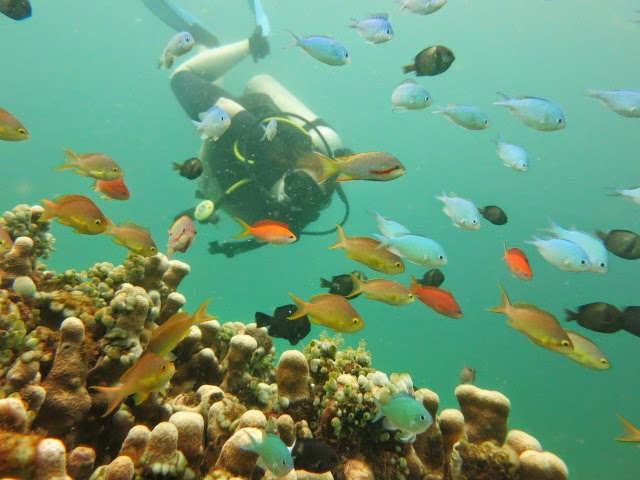
The dives were good, but nothing compared to the Komodo Islands (I may never be impressed with a dive again). We stopped for lunch on Gili Air, where I walked around on my own for a while: it seemed like a nice, low key place, with more tourists than Senggigi but not crowded, with cozy cafes and bars lining the beach.
Can't get enough of these little guys


The following day, I left the hostel at 7:30 for the last leg of my trip to Java: a bus/ferry/bus/ferry combo to Banyuwangi, where I was planning to meet a friend heading there from Bali. I'd been told there was a bus at 9:00 and that the trip would take about 6 hours. This seemed like a remarkably low estimate, given that the ferry from Lombok to Bali alone takes 5 hours, and from there we'd need to travel across Bali and hop another ferry to Java, so I extended the estimate to 8 hours. This turned into my biggest travel disaster to date. At the bus station I was told the bus would leave at 10, not 9. It didn't end up leaving until noon, but everyone was content to just wait on the bus while snack tours and guitar players got on and walked through the aisle, hoping for some cash. It was only an hour to the Lombok ferry port, and we were given a lunch package of (cold) rice, tempe, lettuce, and (questionable) chicken. We got off the bus and joined to other ferry riders on the passenger deck. I sat next to a local woman who offered me a little banana leaf packet of sticky rice. I thanked her and took one: it was bizarrely spicy and sweet and salty all at once (I think there was both banan and meat inside) and she spent the next five hours insisting that I take more, completely disregarding my replies tbTi wasn't hungry. I was relieved when we reached Bali around 7 pm and could get back on the bus. Meanwhile, my friend had expected me in Banyuwangi around 6, and I had no means of contacting her without wifi. As it got later and later I tried everything I could think of to reach her, but was unsuccessful. In the end, I just hoped that she'd given up and headed to a hotel (although since we'd never agreed on one I had no hope of finding her until I found wifi). Traveling across Bali took hours - much longer than I'd guessed because of traffic. It was also dark, meaning that I didn't even get to enjoy the scenery during the ride. We stopped for dinner (rice, tempeh, egg) at a small restaurant around 9, then hit the road again. I was so relieved when we finally got to the western dock in Bali and boarded the second ferry of the day, around 11 pm. This one was shorter: less than two hours, and I ran off the boat. I felt like kissing the ground, I was so glad to have reached Java. It was too late to head up to Cemoro Lawang, though I'd planned to spend the night there; instead I grabbed a motorbike taxi to a hostel in town. Finally connecting to wifi, I saw that my friend had reached Cemoro Lawang. I wished I had just headed there (I could have motorbikes all the way up there from the ferry): instead I promised to get there early the following morning and instead slept in a profoundly crappy hotel room (dirty sheets, cold bucket shower, suspicious stains on the walls). At 1 am,17 and a half hours after leaving the hostel in Senggigi, I was too tired to worry long about it (although I did wrap the pillow in a t-shirt before putting my head on it). The clock striking midnight outside, reminding me that Java is an hour behind Bali and Lombok, was very little consolation.